


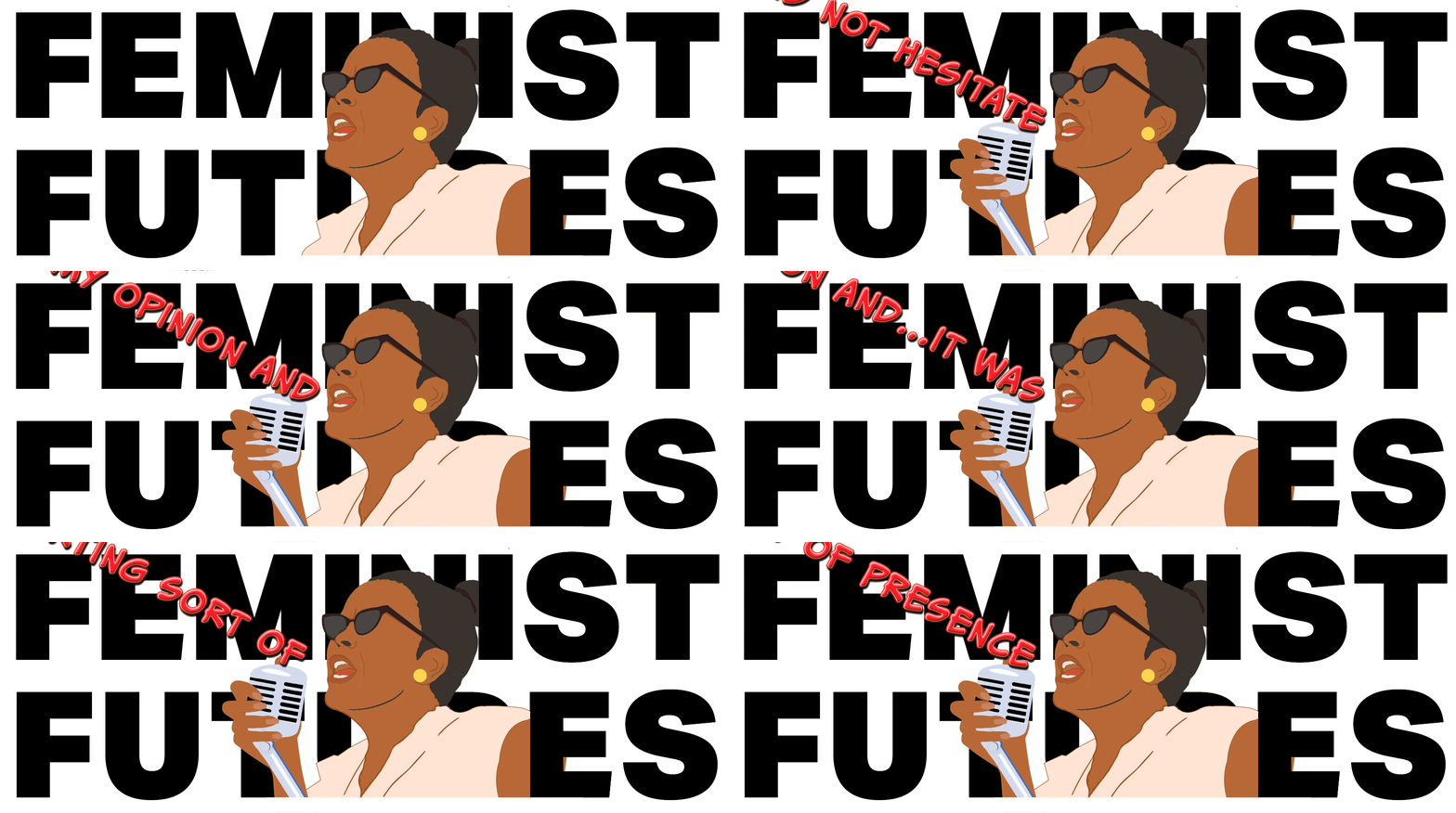
Dr. Barbara Ransby is a leading American historian, writer, and activist. A longtime scholar of, and participant in, movements for radical change, Dr. Ransby is the author of three books, including the award winning, Ella Baker and the Black Freedom Movement. Dr. Ransby’s writings have introduced new generations to the ways in which Black feminists have organized movements for freedom in the United States. Ella Baker, as a foundational organizer in twentieth century struggles for Black freedom in the United States, modeled and advocated a different kind of leadership than that of the charismatic, authoritative male leader at the helm of movements. With much critique being directed at “leaderless” women*-led movements around the world, and especially in Iran, Feminist Futures sat down with Dr. Ransby to discuss alternative practices of leadership and the commonalities of struggle among uprisings around the world today.
FEMINIST FUTURES: Dr. Ransby, we wanted to get started with your work on Ella Baker; what made you want to write a biography about her? And what makes her so relevant to this particular moment that we’re living in now, with so many uprisings happening around the world, many of them led by women and being informed by feminist lexicons and discourses? Might we consider how Ella Baker’s practice, as well as her theory of social change and political organizing, are not only historical instances that we can learn from, but can help us think about the current moment?
BARBARA RANSBY: Thank you for that question, and for your work and your intervention right now. This year, 2023, is actually the 20th anniversary of the book, Ella Baker and the Black Freedom Movement—it’s hard to believe it’s been that long. And so in some ways, your question is as much about the conversations and interactions and struggles that I’ve been involved in over the last 20 years, as people have read the book and learned more about Ella Baker, as it is about what my intentions were when I wrote it. Ella Baker, of course, challenges us to think differently about leadership. She warns about the dangers of messianic leadership, of investing in prophets and saviors. And she's a sort of proto-feminist. I mean, she doesn’t claim the term “feminist,” per se, and she comes out of a certain era where that word had different resonance.
But she is very much in the Black feminist tradition in that she centered the most marginal voices and individuals in the communities that she organized in. She went into communities in the deep south and she didn’t speak to the people who had official titles, either academic or clerical, or people in the business world. She looked at people who were criticized as being not the most respectable members of the community, people who were economically disenfranchised, people who were politically disenfranchised—even within Black communities where she was organizing—and she saw a certain power there. Her view was that if we organize movements centered on the experiences and knowledge of some of the most marginalized forces, then we build stronger movements. We build more just movements. We build more holistic movements. And it is that approach to leadership that centered poor and working class women, and young people, who were some of the most important visionaries and fighters in the southern-based Black Freedom Movement of the 1950s and 60s.
And of course, because patriarchy is longstanding and worldwide, women—because of positionality not biology—become an important force in any movement for radical change. This was really critical to Ella Baker’s thinking and practice throughout the years. She also asked that movements develop structures that were radically democratic; that organizations that had a mass base should not just rely on those members to pay dues and support a sort of “enlightened leadership” at the top, but rather, that there had to be mechanisms for people to have input to make decisions and shape the contours of the struggles that they were being asked to be soldiers in. So, she had a vision of a different kind of democratic society, but she also insisted on those practices inside movements.
I know that your project is interested in “leaderlessness.” So I’ll just foreshadow questions about that by saying that I don’t really use the term leaderless. Ella Baker took up a certain kind of leadership; that is, leadership that was accountable to people, leadership that was at the center of a movement, leadership that was transparent, and leadership that was not all powerful. But it was still people who guided other people, who mobilized other people with the responsibility to do political education among the general public, develop strategies, etc. That was her life’s work. She was an organizer, but I would also describe her as a people’s leader, which is different from a big leader or a top-down charismatic leader or hierarchical leader.
So, she [Ella Baker] has a lot of relevance for us today. In my book, Making All Black Lives Matter: Reimagining Freedom in the Twenty-First Century, I talked about the young, queer feminists who were at the center of what is commonly referred to as “Black Lives Matter,” and they were very much inspired by the tradition of Ella Baker and her leadership style. They were also radically inclusive, looking at people who were just outside the bounds of respectability and centering those people in their work and their demands for an end to police violence, which targets people not just based on race, but also based on class. That’s why I see all kinds of echoes of Ella Baker’s ideas and praxis among twenty-first century movements; from Black Lives Matter/Movement for Black Lives, to Occupy Wall Street, to the recent uprising in Iran. And this tradition of radically inclusive non-hierarchical organization doesn’t just belong to Baker, it belongs to the world, and it’s a part of, I think, people demanding movements that look like the world that they want to live in and not just movements that are about seizing power.
FEMINIST FUTURES: Let’s expand on that last point. What can we learn from organizers such as Ella Baker, the Movement for Black Lives, and other Black radical feminists about organizing movements in the face of the repressive, centralized powers we see all around the world? “Strong people don’t need strong leaders,” was a statement that Ella Baker made in deference to the need for organizations to alter their very concept of leadership. She was a people’s leader, as you mentioned. Can you elaborate on the discontents around conventional forms of messianic leadership, and what movements for radical change stand to gain in molding a concept of leadership different from the one we’ve been rendered predisposed to?
BARBARA RANSBY: The answer is nuanced. The “horizontilidad” movements in Latin America, Occupy Wall Street, and many other protests are informed by certain anarchist traditions, which were all a response to a very hierarchical left that we’ve seen around the world; the vanguard parties, and the notion of democratic centralism, which was more central than democratic. The call for leaderlessness is a response to that. It’s also a response to patriarchal top-down social movements that weren’t revolutionary, that called upon people to invest in a single all-knowing individual who would lead us to salvation. And we see that in the way Martin Luther King Jr. is depicted and deified, and how Malcolm X is exalted and remembered, and a number of others. These leaders are often male, that comes with the territory, and that’s how we’re socialized to see leadership. And that’s how we’re socialized to really see it in history, as “great deeds, great men.” And so, the message is, we need to find our “great man” to lead and galvanize our movements. And this generation is saying no to that approach.
“Leaders have to be embedded in struggle; they are not above their organizations, but in some cases asked to represent organized forces. And to lead doesn’t mean to pull along by the nose. Radical democratic leadership means to be a catalyst for collective will.”
I think the democratic impulse within our movements now, which is informed by feminism as well some of the anarchists traditions, pushes back against antiquated notions of progressive leadership, clearly. But where nuance comes in is that we have to strike a balance between moving in a coordinated fashion and including all voices. There is also a danger in what Jo Freeman once called the “tyranny of structurelessness.” That is, Freeman asked how do we say there are no leaders in the context of a society that’s always looking for a leader and a spokesperson, from media, to philanthropy, to government? People inevitably emerge as spokespersons, even while they’re claiming to not be a leader, and individuals disconnected from movements and mechanisms of collective decision-making can co-opt the political message, sentiments, and goals of a movement. The way we operate in that context is to say that leaders have to be accountable. Leaders have to be embedded in struggle; they are not above their organizations, but in some cases asked to represent organized forces. And to lead doesn’t mean to pull along by the nose. Radical democratic leadership means to be a catalyst for collective will. That’s what I think of as democratic, feminist informed leadership. As I mentioned, I move a little bit away from leaderless because I see dangers in that. And I am much more comfortable with local democratic, accountable leader organizers, as a model for our movements.
Let me segue a bit to the question of internationalism and international solidarity. We look at different parts of the world and kind of reify or fetishize movements; we were “for” the South African people, or are for the Iranian people, or for the Palestinians. But there’s a real struggle over ideas, beliefs, goals, and principles going on in real time in all those places. And so we do have to look to organizational formations at some point to ask, “where are the spaces that people have come together to argue out and build consensus on what they believe, as a group, as a whole, which will inescapably differ from other people who occupy that same land mass?” So, generic expressions of solidarity are by definition shallow expressions. Solidarity has to be grounded in forging a shared vision for a different world. And we have to do that in a holistic way, in a democratic way. That gets at what we want in the long run. It is easier said than done.
“So, generic expressions of solidarity are by definition shallow expressions. Solidarity has to be grounded in forging a shared vision for a different world. And we have to do that in a holistic way, in a democratic way. That gets at what we want in the long run. It is easier said than done.”
FEMINIST FUTURES: That leads us in some ways to a question about the commonalities in the uprisings around the world. All around the globe, there’s growing incarcereality; growing control or attempted control of our bodies; the use of drones and apps to track activists and protesters from the United States to Iran to Palestine, China and so on; as well as the use of facial recognition technologies worldwide to further target systemically disenfranchised communities—for example in Iran, just in the past few weeks, there’s been increased attempts to enforce compulsory veiling through facial recognition technology. Of course, at the center of all these cancerous growths is the patriarchal ethos of everyday domination and violence.
Scholars like yourself and Robin D. G. Kelley speak about the need for solidarity that’s based not on common oppression, but on common resistance. We see how often there is a sense among protestors in different geopolitical contexts that “okay, because my struggle doesn’t look exactly like the other movement that’s happening, we’re sort of dealing with different things,” and this sense precludes solidarity with others facing seemingly different forms of oppression. But “the commonality of resistance” is a really powerful idea and potential antidote to such barriers to solidarity, and we’d love to hear your thoughts on this.
BARBARA RANSBY: I love Robin D. G. Kelley. He’s one of my close friends, and a very close comrade and colleague. I would say there’s both a commonality of oppression and a commonality of resistance, and solidarity gets forged across both. You know, we live in an era of global racial capitalism, and global racial capitalism is in crisis. The elites are competing with each other for different ways to respond to that multi-faceted crisis, and we have to understand the transnational nature of our problems, and our enemies quite frankly. As we craft strategies of resistance, we have to become fluent in one another’s struggles. There’s a global struggle and there are particular national struggles. We have to do the work of solidarity which is about research and relationships. We have to have forums that are multinational, we have to build translation and interpretation into those, otherwise we’re talking about each other, but not to each other. We have to organize solidarity delegations and transnational study groups.
We have a project here called the Portal Project, which has involved scholars, activists, and artists across the U.S. and from Brazil and Haiti and Canada. We’ve talked about economic justice and racial capitalism, prison abolition, and climate justice as critical entry points for understanding opportunities for social transformation in this period. We always try to look locally, nationally, and globally in each of these areas. There are others that are building important transnational networks and conversations. Grassroots Global Justice Alliance is one group that has centered women around the world. And there are networks of transnational feminist scholars. I think one of the real challenges is how to also involve women doing grassroots organizing, women and men who are not plugged into academic networks, who are struggling in their communities, trying to find or form organizations that help them fight in a very day-to-day way for both survival and for more fundamental changes. Oftentimes, they don’t get to travel internationally or get invited to transnational forums, and so forth. And so we need to deal with that class reality as we try to form solidarity across the globe.
I'm often inspired by the words of the poet June Jordan, who was a Black poet grounded in the Black Freedom Movement. In expressing solidarity for the Palestinian struggle, she said, “I was born a Black woman and I became a Palestinian.” Now, some people might think that’s controversial—to “become” part of another people that occupies a certain culture. Yet it’s very provocative in another way, because a lot of times we do talk about “our people.” And I say that too, and in part, I mean Black people in the U.S. That’s the community I grew up in and those are the people who loved me from very early on. But I also mean other people around the world: people whose language I don’t speak, people who I’ve never met, people who by positionality are oppressed, but are making a choice to resist and to build. To me, those two axes are important because everybody who’s oppressed is not actively resisting for a variety of reasons. They’re busy trying to survive. However, there are resistance movements that we can be in solidarity with, but to do so we have to do our homework: we have to have our interactions about global issues occur in a way that’s accessible beyond narrow networks, the discursive networks that some of us exist in. It’s an approach and a practice. But I am utterly convinced that we will never have freedom or serious emergence of justice unless we build the kind of movement that transcends national boundaries.
“As we craft strategies of resistance, we have to become fluent in one another’s struggles. There’s a global struggle and there are particular national struggles. We have to do the work of solidarity which is about research and relationships. We have to have forums that are multinational, we have to build translation and interpretation into those, otherwise we’re talking about each other, but not to each other. We have to organize solidarity delegations and transnational study groups.”
FEMINIST FUTURES: Because there is an ever increasing ease in instantaneous global communication, we are more aware than ever of the worldwide echoes of organizing for the takedown of dominant structures of power everywhere. And there is the critique that a radical politics that calls for bringing down dominant power structures is only interested in the so-called “easy part” of undoing, rather than the complicated part of building something up. But in actuality, as Jack Halberstam points out in their work on the aesthetics of collapse, institutions and networks of power are incredibly hard to take apart. What do you think informs the roots of this thinking—that taking down is simple to do—and why might resisting this kind of thinking be key to building more solidarity rooted in resistance?
BARBARA RANSBY: Well, I think we have more practice in what we’re against than what we’re for. And we’ve seen that certainly in the socialist movements around the world in the twentieth century. People were against capitalist exploitation, people were against imperialism and dictatorships, but then what do we build in the wake of that? Sometimes there’s this period of what [Antonio] Gramsci called the interregnum, the period between the falling apart or dismantling of something, and the building or emergence of something new. There’s a dialectic between dismantling and building. And if we fail to understand this, then we will both fail to dismantle and to build effectively.
I see hope in the restorative justice movement, for example. There is the attempt to build something new at the same time that they critique carceral structures. I see it happening with the solidarity economies that are forming, representing a different kind of economic model taking shape. On a local level in our organizations and structures there are alternative movements being forged that represent new forms of decision-making and self-governance—a form of participatory democracy that is local.
Here in Chicago, we’ve just had a progressive mayor elected, and we’re right at that moment of dislodging an administration that was not in service to progressive—and certainly not radical—agendas and figuring out what that dismantling means. What does winning mean in this context when we still have all the structures that existed before firmly in place, but we now have new people in power? When you have the outsiders become insiders, but what they're inside of is still an oppressive hierarchy, that poses a dilemma. So how do we then understand the potential and limitations of an inside-outside strategy? These questions persist.
FEMINIST FUTURES: After the Ferguson uprising in response to the violent police killing of 18-year-old Michael Brown in 2014, you convened an intergenerational group of activists. We’ve also heard you speak and write about the importance of Black internationalism in activism. You mentioned in one event: “We can’t understand ourselves without understanding the world.” What is the importance of having an international outlook that is intergenerationally informed? And how can we create spaces for intergenerational work that is not hierarchical but rooted in egalitarian practices that work towards resistance? Ella Baker, as you wrote, “was part of a powerful, yet invisible network of dynamic and influential African American women activists who sustained civil rights causes, and one another, across several generations.” How might we build sustainable global networks of women and non-binary activists in 2023 using the roadmap provided by these women?
BARBARA RANSBY: I say I’m a Yelder: not just an elder, but a young elder. I think we have to walk in these spaces with humility. As a historian, I understand that no historical moment is identical to another. And we sometimes use these clichés that “history repeats,” but it actually doesn’t. It can’t. We all have to appreciate our positionality in time, and a lot of elders don’t appreciate that and they talk down to the younger people as if experience and age automatically translates to superior wisdom. But of course we have things to learn from each other across those divides of experience. And I'm always learning something when I’m in these spaces with young people. Ella Baker was often the older person in the room too, especially when she was working with SNCC [the Student Nonviolent Coordinating Committee]. We can’t fetishize age either, this idea that “just let the young people lead, they’re more emboldened,” that’s not always the case. You have youth activists that are conservative, literally meaning right-wing, and then you have ones that are more cautious and more moderate than some elders. Each generation has its own contradictions and political struggles, but also each generation includes a range of political ideas along a spectrum.
The third thing I’d say is about this generation of activists across the world—and I’ve talked to activists in many parts of the world including Europe and Africa and Sub Saharan Africa and the Middle East and North Africa and Latin America—and what’s struck me over the last 15 years or so are the number of young women who are at the center as theorists, as strategists, as people leading movements in the street. In Puerto Rico when they ousted the governor a number of years ago, young women were really right at the center in groups like Colectiva Feminista en Construccion. And so for me, I see in this generation a sort of holistic politics. You can call them intersectional politics, yet I don’t think we have to call them intersectional to see the holistic nature of them. They are saying that no group gets thrown under the bus. They are challenging patriarchy as a central force in our radical imaginations that limits us looking forward and limits the possibilities that we see for humanity. That is a real hopeful thing for me. And I think my generation was not as sharp and clear and savvy on questions of gender and sexuality. I mean, there were those of us who were feminists when it certainly wasn’t popular, but in a way our goals were more modest. I see this generation as much more…I don’t want to say advanced in a linear sense, but just sharper and clearer on that.
As our conversation with Dr. Ransby drew to a close, we were reminded of an essay she wrote for International Women’s Day in 2022. With the backdrop of wars, corruption, state violence, the climate crisis, and everyday acts of violence, it is hard not to become cynical or to disengage because the problems around us seem so entrenched and insurmountable. Yet Dr. Ransby consistently emphasizes the importance of fortifying ourselves and bolstering our resolve to fight for a better world, she writes: “Looking ahead, we need a revolution of values, systems, and cultures. And feminist organizers and cultural workers must, as the late writer-activist Toni Cade Bambara reminded us, ‘make revolution irresistible.’ That is our task. Let’s embrace it.”
ABOUT THE INTERVIEWEE

DR. BARBARA RANSBY is the John D. MacArthur Chair and Distinguished Professor of History, Gender and Women’s Studies, and Black Studies at University of Illinois at Chicago where she directs the Social Justice Initiative. She is also the author of three books, including the award winning, Ella Baker and the Black Freedom Movement. Dr. Ransby is a longtime Black feminist activist, author and scholar, and has received numerous awards for her work including the Angela Y. Davis award from the American Studies Association, Frantz Fanon Lifetime Achievement Award from the Caribbean Philosophical Association and the Freedom Scholars Award from the Marguerite Casey Foundation. In 2020, Dr. Ransby was elected as a fellow to the Society of American Historians. She publishes widely in various scholarly and popular venues and is past president of the National Women's Studies Association (2016–2018). In 2017, Dr. Ransby was honored as “one of the top 25 women in higher education,” by the publication, Diverse: Issues in Higher Education.
MORE FEMINIST FUTURES


